


Recently, parts of the Middle East have experienced periods of instability that have put pressure on everyday infrastructure, including power supply in certain areas. At the same time, daily life continues — people still travel, work, shop, and rely heavily on their mobile phones.
In moments like these, one simple issue becomes very real: running out of battery is no longer just inconvenient — it can disrupt communication, access to information, and even basic daily activities.
This shift is turning shared power banks from a “nice-to-have” service into something far more practical.
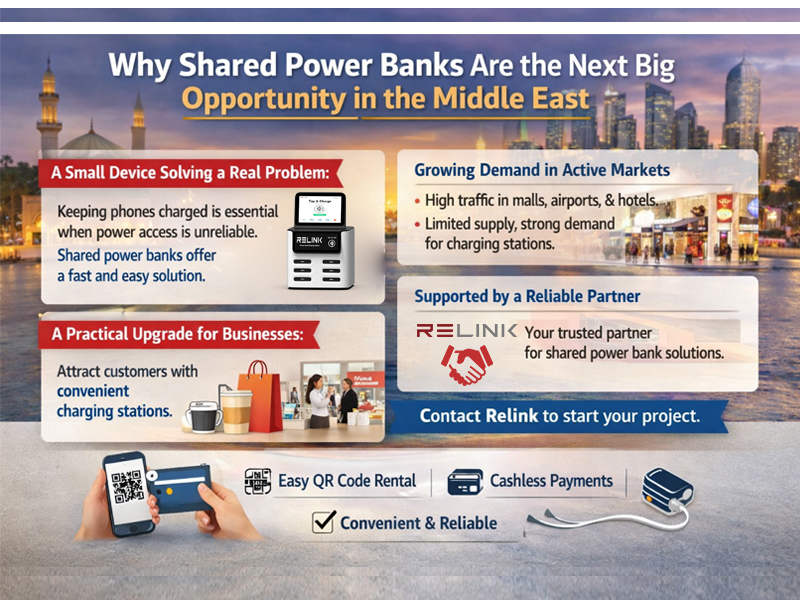
A Small Device Solving a Real Problem
For most people, a phone is more than just a device — it’s a wallet, a map, a communication tool, and a source of information. When power access becomes less predictable, even temporarily, keeping a phone charged becomes essential.
Shared power banks offer a simple and immediate solution. Users can rent one within seconds, continue using their phone while on the move, and return it at another nearby location. There’s no need to carry personal chargers or search for sockets.
In everyday situations, this convenience matters more than people expect. Someone shopping in a mall can continue browsing instead of leaving early. A traveler at the airport can keep their boarding pass accessible. A delivery driver or business visitor can stay connected throughout the day.
These are small, practical moments — but they happen constantly, and they create real demand.
Growing Demand in Active Markets
In countries such as Saudi Arabia, the United Arab Emirates, and Qatar, economic activity remains strong. Shopping centers, restaurants, hotels, and airports continue to see steady foot traffic, especially with the return of tourism and business travel.
At the same time, shared power bank services are still not widely available in many areas. This creates a clear opportunity: demand already exists, but supply is limited.
What makes the region even more suitable is user behavior. Cashless payments are already common, and people are comfortable using QR codes and mobile services. This makes it easy to introduce shared power banks without requiring users to change their habits.
A Practical Upgrade for Businesses
For business owners, shared power banks are a simple way to improve customer experience without adding complexity.
Placing a charging station in a visible location — near entrances, checkout counters, or seating areas — gives customers an immediate solution when their battery is low. In return, businesses often benefit from longer customer stays and increased satisfaction.
It’s a small addition, but it directly addresses a real need. And in competitive environments like malls or hospitality venues, these small improvements can make a noticeable difference.
Supported by a Reliable Partner — Relink
Entering a new market always comes with uncertainty, which is why having a reliable partner is important.
Relink, as an experienced provider in the shared power bank industry, offers a complete solution that includes hardware, system support, and deployment experience. The focus is not only on product quality, but also on long-term stability — ensuring that partners can scale their operations with confidence.
This is especially important because shared power bank projects are not short-term. Once deployed, they require consistent supply, stable systems, and ongoing support. Working with an experienced supplier helps reduce risk and ensures smoother operations from the beginning.
Looking Ahead
The situation in the Middle East today highlights a simple reality: people depend on their phones more than ever, but access to power is not always guaranteed.
Shared power banks address this gap in a direct and practical way. They don’t require major changes in behavior, and they provide immediate value in both daily and unexpected situations.
What was once seen as a convenience is quickly becoming part of essential urban services. For businesses and operators, this represents a real opportunity — one built not on trends, but on genuine, everyday needs.
Contact Relink to start your project
Post time: Mar-20-2026