


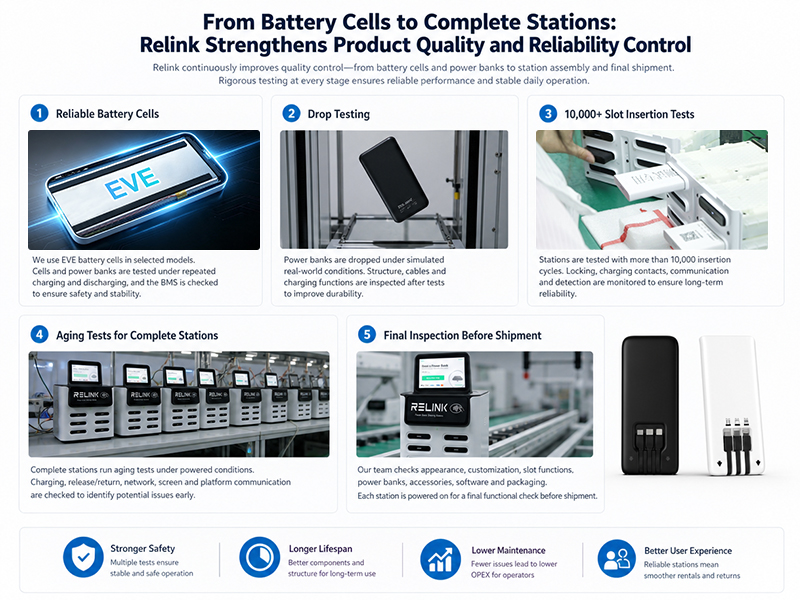
As shared power bank services expand into more markets and high-traffic locations, equipment reliability has become increasingly important for operators. A station may be used hundreds of times each day, while power banks are repeatedly rented, returned and recharged. To support long-term commercial operation, Relink continues to improve its quality control system—from the selection of battery cells to final inspection before shipment.
Reliable Battery Cells as the Foundation
The battery cell is one of the most important components of a power bank. Relink uses EVE battery cells in selected power bank models to provide stable capacity, consistent performance and a longer service life.
Battery cells and finished power banks are tested under repeated charging and discharging conditions. Cycle-life testing helps our engineering team evaluate capacity retention, charging performance and battery stability after extended use. The battery management system is also checked to ensure proper protection against overcharging, over-discharging, excessive current and short circuits.
Drop Testing for Daily Rental Environments
Shared power banks are frequently carried and used in restaurants, shopping centres, hotels, airports and other public locations. Accidental drops are therefore unavoidable.
To simulate real operating conditions, Relink conducts drop tests on power bank samples. The housing, internal structure, cables and charging functions are inspected after testing. These tests allow our team to identify potential weaknesses and improve the internal support structure, material selection and assembly process.
More Than 10,000 Slot Insertion Tests
The station slot is another component that directly affects the user experience. Each power bank must be released smoothly, returned correctly and connected reliably for charging and data communication.
Relink performs repeated insertion and removal tests on station slots, with a testing target of more than 10,000 cycles. During the process, our team monitors the locking mechanism, charging contacts, communication performance and power bank detection. This helps reduce problems such as unsuccessful returns, poor contact or slot failure during long-term operation.
Aging Tests for Complete Stations
Before shipment, complete stations undergo aging tests under powered operating conditions. Key functions—including charging, power bank release and return, network connection, screen operation and communication with the management platform—are checked over an extended period.
For models equipped with display screens, the screen, control board, power supply and temperature performance are also inspected. The purpose is to identify unstable components or assembly issues before the equipment leaves the factory.
Final Inspection Before Shipment
Every shipment goes through a final inspection process. Our quality control team checks the product appearance, logo and colour customization, slot functions, power banks, accessories, software configuration and packaging.
Each station is also powered on for a final functional check. For customized projects, the team verifies the required server settings, communication configuration and branding details according to the confirmed order information.
Quality improvement is an ongoing process rather than a one-time task. By strengthening testing at each stage—from battery cells and power banks to station assembly and final shipment—Relink aims to provide operators with reliable equipment, lower maintenance requirements and more stable daily operation.
Post time: Aug-07-2026