


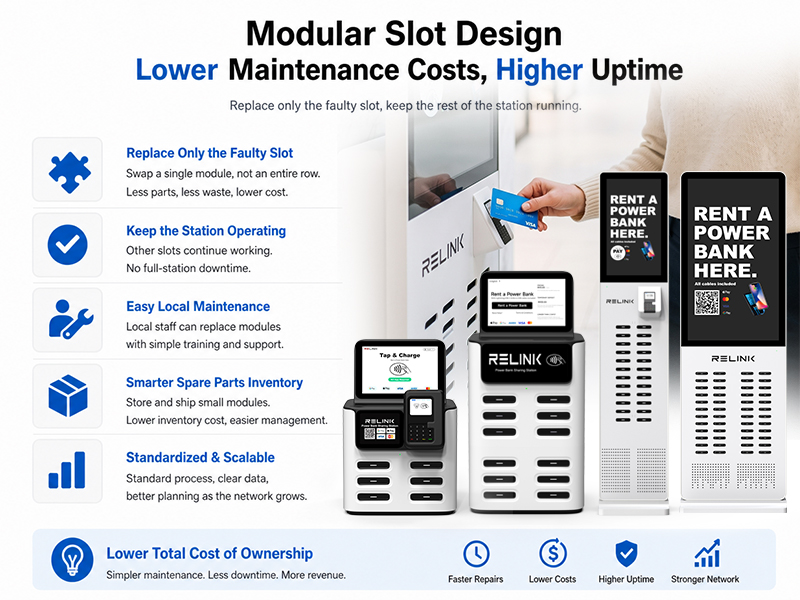
When operators compare power bank rental stations, they often focus first on the unit price, battery capacity and software functions. These factors are important, but they do not show the full cost of running the equipment.
Once a network expands to hundreds or thousands of stations, maintenance becomes a daily operational issue. A station may have one slot that cannot lock a power bank correctly, fails to charge it or does not recognize when it has been returned. The way the station is designed determines whether this is a simple replacement or a time-consuming repair.
This is where modular slot design makes a practical difference.
Repair Only the Part That Has a Problem
In a modular station, each slot is designed as an individual serviceable unit. If one slot develops a fault, the technician can inspect and replace that particular module instead of changing an entire row of slots or removing several working components.
This sounds like a small design detail, but the cost difference becomes noticeable as the network grows. Replacing one faulty module requires fewer spare parts and creates less waste than replacing a larger assembly.
It also makes fault diagnosis more straightforward. The operator can identify the affected station and slot, arrange a replacement and send the faulty module back for inspection if necessary.
Keep the Rest of the Station Operating
A problem with one slot should not take the whole station out of service.
With a modular structure, the affected slot can be disabled while the remaining slots continue to support rentals and returns. Customers can still use the station, and the venue does not lose the entire service while waiting for maintenance.
This is particularly important in busy locations such as shopping malls, restaurants, airports and entertainment venues. At these sites, several days of complete downtime can mean lost rental income and complaints from both users and business partners.
Keeping most of the station operational helps reduce that loss.
Make Local Maintenance Easier
For a network operating across several cities, sending an experienced engineer to every location is rarely practical. Travel expenses may cost more than the component being repaired, while waiting for an engineer increases the station’s downtime.
Modular slots allow more maintenance work to be completed by local operational staff. With basic training, clear instructions and remote technical support, a local employee can remove the affected module and install a replacement.
The damaged module can then be returned to a central service location for detailed inspection. This allows the operator’s main technical team to handle repairs in batches instead of travelling repeatedly to individual venues.
Reduce Spare-Parts Inventory
Operators need to keep spare parts available, but storing complete assemblies for every station model ties up capital and warehouse space.
Individual slot modules are easier to store, count and ship. Rather than keeping several large replacement assemblies, an operator can maintain a smaller stock of commonly used modules and distribute them according to actual maintenance needs.
This also makes inventory planning more accurate. By reviewing maintenance records, operators can see which parts are used most frequently and adjust their stock accordingly.
Support Standardized Maintenance as the Network Grows
A small pilot project may rely on one person who understands every station. That approach becomes difficult when the business expands to hundreds of locations.
Modular equipment supports a more standardized process. The operations team can record the station number, identify the affected slot, replace the module and document the result. Faulty modules can then be collected for inspection, repair or failure analysis.
This creates useful maintenance data. Over time, the operator can identify recurring issues, compare performance between locations and improve preventive maintenance.
Look Beyond the Initial Purchase Price
A cheaper station is not always less expensive to operate. Before selecting a supplier, operators should ask several practical questions:
- Can a single slot be replaced independently?
- Will one faulty slot stop the entire station?
- How long does a normal slot replacement take?
- Can local staff complete the replacement?
- Are spare modules available for long-term operation?
- Can the supplier provide remote technical guidance?
These questions are especially important for operators planning a large rollout. A small difference in repair time or spare-part cost can have a significant financial impact when repeated across an entire network.
Relink offers modular power bank rental stations in different capacities, including 6-slot, 12-slot, 24-slot and 48-slot configurations. The modular structure is designed to simplify maintenance, reduce unnecessary component replacement and help operators keep more stations available for rental.
For a power bank rental business, modular design is not simply a hardware feature. It is part of building a network that can be maintained efficiently as the business grows.
Post time: Sep-14-2026