


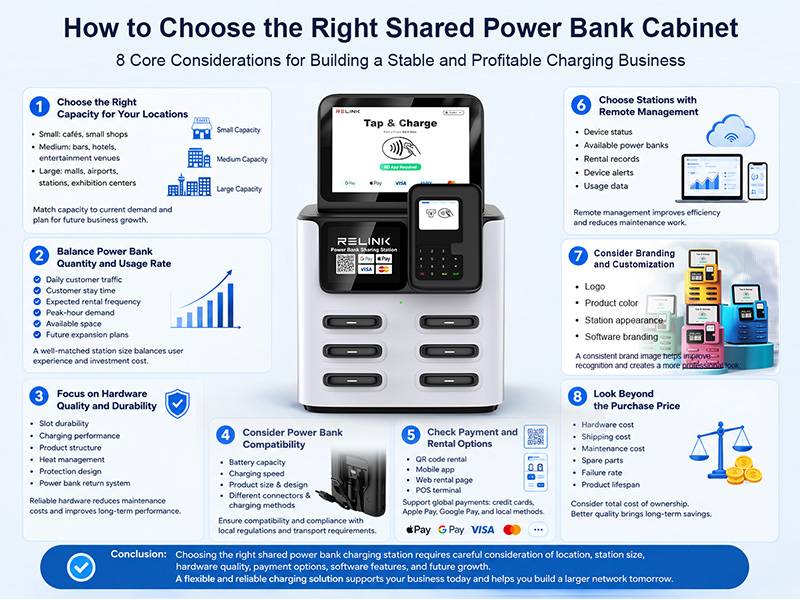
For shared power bank operators, the charging station is one of the most important parts of the entire charging network. Different locations, customer traffic, and business sizes require different station capacities, functions, and designs.
Choosing the right charging station can improve user experience, increase device usage, and reduce long-term operating costs.
So, what should you consider when selecting a shared power bank charging station?
1. Choose the Right Capacity for Your Locations
Different locations have different charging needs, so one type of station does not fit every scenario.
For example:
- · Restaurants, cafés, and small shops: Small-capacity stations are usually enough for daily use.
- · Bars, hotels, and entertainment venues: Medium-capacity stations may be a better choice.
- · Shopping malls, airports, train stations, and exhibition centers: Large-capacity stations are more suitable for high-traffic locations.
When selecting station size, it is important to consider not only current demand but also future business growth.
2. Balance Power Bank Quantity and Usage Rate
The number of slots determines how many power banks can be rented at the same time.
If the station is too small, users may not find available power banks during busy hours. If it is too large, some devices may remain unused, increasing investment costs.
Before making a decision, consider:
- · Daily customer traffic
- · Customer stay time
- · Expected rental frequency
- · Peak-hour demand
- · Available space
- · Future expansion plans
A well-matched station size can help balance user experience and investment cost.
3. Focus on Hardware Quality and Durability
Shared charging stations are designed to operate continuously and handle frequent rentals and returns every day.
When choosing a station, pay attention to:
- · Slot durability
- · Charging performance
- · Product structure
- · Heat management
- · Protection design
- · Power bank return system
Reliable hardware helps reduce maintenance costs and improve long-term performance.
4. Consider Power Bank Compatibility
The charging station and power banks should work together smoothly.
Make sure the power banks support the charging needs of most users, including different phone connectors and charging methods.
It is also important to consider:
- · Battery capacity
- · Charging speed
- · Product size and design
For international projects, you should also check whether the battery products meet local regulations and transportation requirements.
5. Check Payment and Rental Options
A modern charging station is more than just a cabinet for storing power banks. It should work together with software and payment systems.
Common rental methods include:
- · QR code rental
- · Mobile app
- · Web rental page
- · POS terminal
For overseas markets, support for credit cards, Apple Pay, Google Pay, and local payment methods can improve the user experience.
Before choosing a station, make sure it is compatible with the software platform and payment system.
6. Choose Stations with Remote Management
As your business grows, managing devices manually becomes difficult and costly.
A smart management system allows operators to monitor:
- · Device status
- · Number of available power banks
- · Rental records
- · Device alerts
- · Usage data
Remote management can improve efficiency and reduce maintenance work.
7. Consider Branding and Customization
If you plan to build your own brand, customization is also important.
Possible customization options include:
- · Logo
- · Product color
- · Station appearance
- · Software branding
A consistent brand image helps improve recognition and creates a more professional look.
8. Look Beyond the Purchase Price
The lowest price does not always mean the best value.
When comparing charging stations, consider the total cost, including:
- · Hardware cost
- · Shipping cost
- · Maintenance cost
- · Spare parts
- · Failure rate
- · Product lifespan
A reliable product may cost more at the beginning, but it can save money over time.
Conclusion
Choosing the right shared power bank charging station requires careful consideration of location, station size, hardware quality, payment options, software features, and future growth.
A flexible and reliable charging solution can support your current business needs and help you build a larger shared charging network in the future.
Post time: Aug-14-2026