


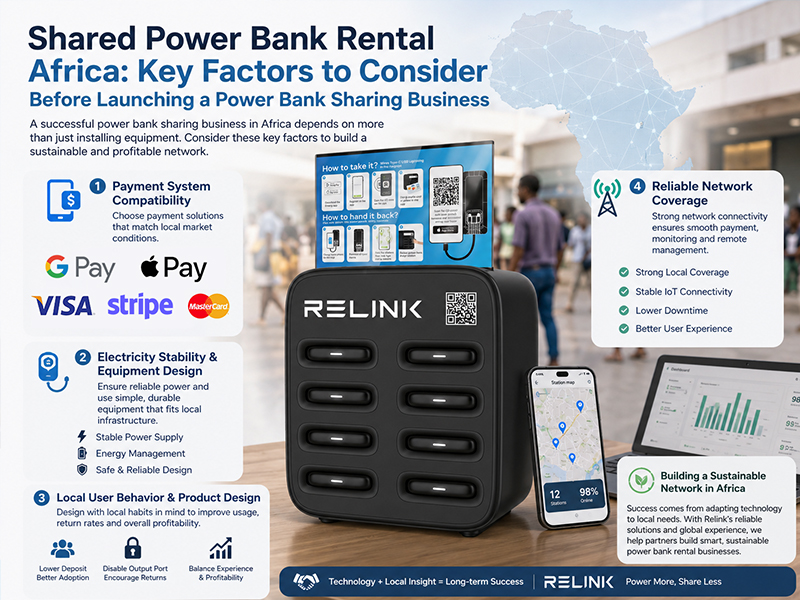
With the rapid growth of smartphones, digital payments, and mobile services, the demand for convenient charging solutions is increasing across many African markets. A shared power bank rental Africa business can provide an effective solution for users who need instant charging access in public places such as shopping malls, restaurants, airports, universities, and transportation hubs.
However, launching a successful power bank sharing station network in Africa requires more than simply installing charging equipment. Unlike traditional retail products, a shared power bank rental business depends on multiple factors, including payment systems, electricity infrastructure, network connectivity, and local user behavior.
Based on experience in global shared charging markets, including solutions developed by companies such as Relink, operators should carefully evaluate the following key factors before entering African markets.
1. Payment System Compatibility Is the Foundation of a Shared Power Bank Rental Business
The shared power bank model became popular in China largely because of the mature mobile payment ecosystem. Users can simply scan a QR code, complete payment through a digital wallet, and rent a power bank within seconds.
Therefore, when developing a power bank rental business in Africa, payment infrastructure is one of the most important considerations.
Different African countries have different levels of digital payment adoption. In markets where mobile payment usage is still developing, operators may need to evaluate whether the local environment is ready for a fully automated shared power bank rental system.
Some companies choose a simpler model by providing charging points and manually distributing power banks to customers. While this approach can solve temporary charging needs, it reduces the advantages of a smart rental system. Without automated payment, device management, and remote monitoring, it becomes much more difficult to build a large-scale power bank sharing network.
A successful deployment requires selecting payment solutions that match local market conditions.
2. Electricity Stability and Equipment Design Are Critical in Africa
A standard power bank sharing station requires continuous electricity to charge power banks and maintain communication with the management system.
However, some areas in Africa may experience unstable electricity supply, voltage fluctuations, or limited access to power infrastructure. These conditions can directly affect the reliability of rental stations.
For outdoor or remote locations, additional solutions such as external power supplies, suitable adapters, and energy management systems may become necessary.
Some operators choose to install built-in batteries inside the rental stations to provide backup power. However, this design may create additional challenges. Equipment certification requirements can become more complicated, transportation costs may increase, and shipping procedures may need to follow dangerous goods regulations.
For developing markets, a simpler and more reliable hardware structure is often more suitable for long-term operation.
3. Local User Behavior Should Influence Power Bank Design
User habits and purchasing power are important factors when building a shared charging station network in Africa.
In many emerging markets, customers may be less willing to pay high deposits for rental services. A high deposit requirement can reduce user adoption and affect the overall utilization rate of the equipment.
To improve return rates, some operators choose to disable the external charging port of rental power banks. This design encourages users to return the power bank to the station after use instead of keeping it as a personal charging device.
However, every design choice has advantages and disadvantages. Blocking the charging port may improve operational control, but it can also reduce additional revenue opportunities from power bank sales.
Operators need to find the right balance between user experience, device recovery rate, and business profitability.
4. Reliable Network Coverage Supports Stable Operations
A shared power bank rental system relies on internet connectivity for payment communication, device monitoring, rental management, and remote maintenance.
The selection of IoT SIM cards is therefore a key factor for successful operation.
When deploying a power bank sharing station in Africa, operators should choose telecom providers with strong local network coverage, especially in areas where rental stations will be installed.
A stable network connection helps improve equipment availability, reduce maintenance costs, and provide a smoother rental experience for customers.
Building a Sustainable Shared Power Bank Rental Network in Africa
Africa represents a growing market with significant opportunities for digital infrastructure and shared economy services. However, successful expansion requires adapting technology to local conditions rather than simply copying existing business models.
From payment integration and hardware design to network selection and operational strategy, every detail can influence the success of a shared power bank rental Africa project.
With experience in shared charging solutions, Relink continues to work with partners worldwide to develop reliable power bank sharing stations and smart charging solutions designed for different market environments.
A sustainable shared charging business is built not only on advanced technology but also on a deep understanding of local requirements.
Post time: Jul-31-2026